
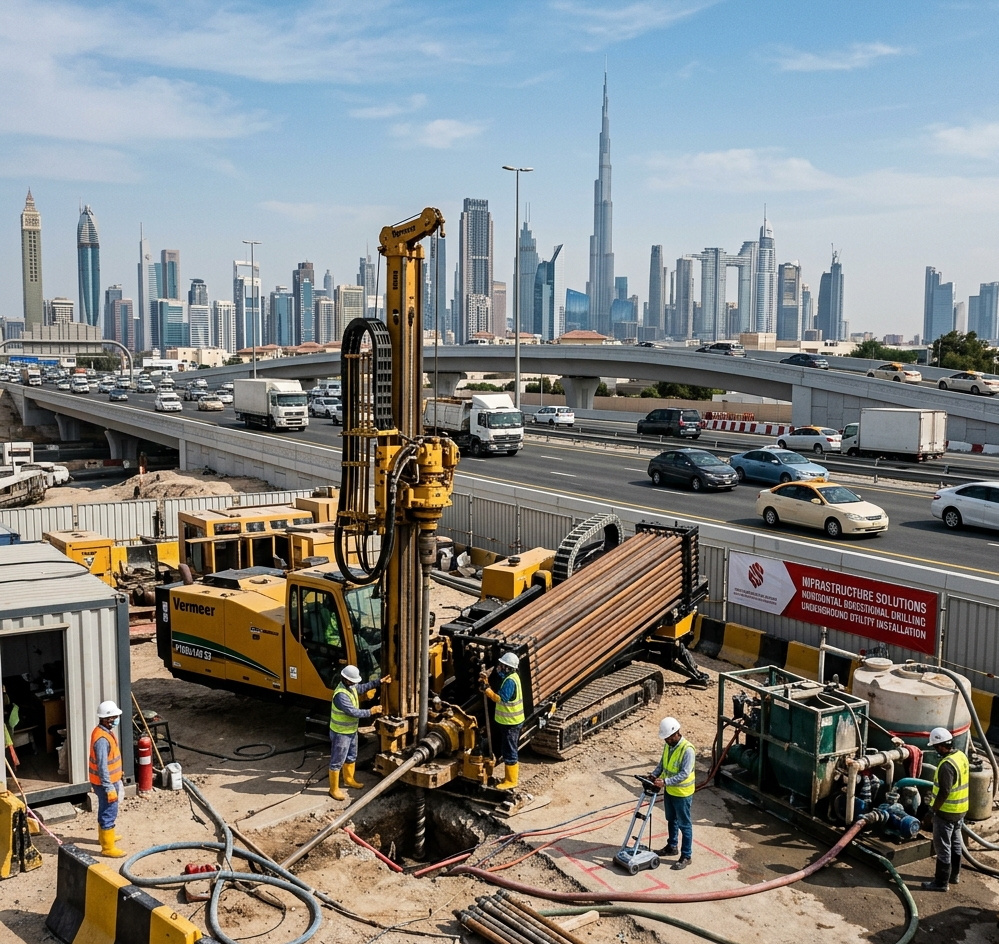
It should be simple to put in underground services that do not interfere with roads, slow down traffic, or annoy people who live nearby in smarter towns. There were times when roads had to be stopped, there was a lot of noise and dust, and expensive repairs were required.
Many building and engineering firms are currently employing NDRC (Non-Disruptive Road Crossing) with HDD technology because of this.
FGC Contracting LLC can quickly and safely set up new power lines, wires, and networks with the help of HDD and NDRC works. They are not required to dig up a lot of roads.
What does the NDRC do?
NDRC” stands for “Non-Disruptive Road Crossing.” For this cutting-edge way to work, there is no need to dig big holes or cut through roads to wire things.
Drilling by means of the ground is a safe way for pipes and wires to cross roads instead of tearing them up.
With this method, people often do these things:
- Pipes for water
- Cords and plugs
- Plans for phone and fiber networks
- Oil and gas lines
Drainage techniques are used to build roads and other infrastructure.
The positive aspect of NDRC is that it does not place excessive stress on construction sites close by, such as traffic and roads.
What does HDD mean?
HDD, which stands for “Horizontal Directional Drilling,” is a smart way to put in underground pipes without having to dig holes.
They use high-tech drills to make a safe way for pipes and cables to be put in below structures, such as highways and railroads.
Since HDD doesn’t need as much digging, it has become the most popular way to build buildings very quickly in the last few years.
How to Do It Step by Step for the NDRC in HDD Projects
- Plan the project and look at the site
The first thing that needs to be done to finish an HDD project well is a lot of planning.
Engineers need to look closely at the area before they can start drilling to:
- What the ground and soil look like
- These are the underground systems that are used now
- Things you need to cross the street
- People should think about safety and the world around them.
There is less risk because the project will go off without a hitch.
- Finding utilities that are buried
Before drilling can begin, some things need to be found and marked.
Looking for:
It has tools that make it easy to find things.
- Water pipes
- Plugs and cords
- Oil and gas lines
- Getting rid of water with phone lines and networks
This is a very important step to make sure that drilling doesn’t hurt anything.
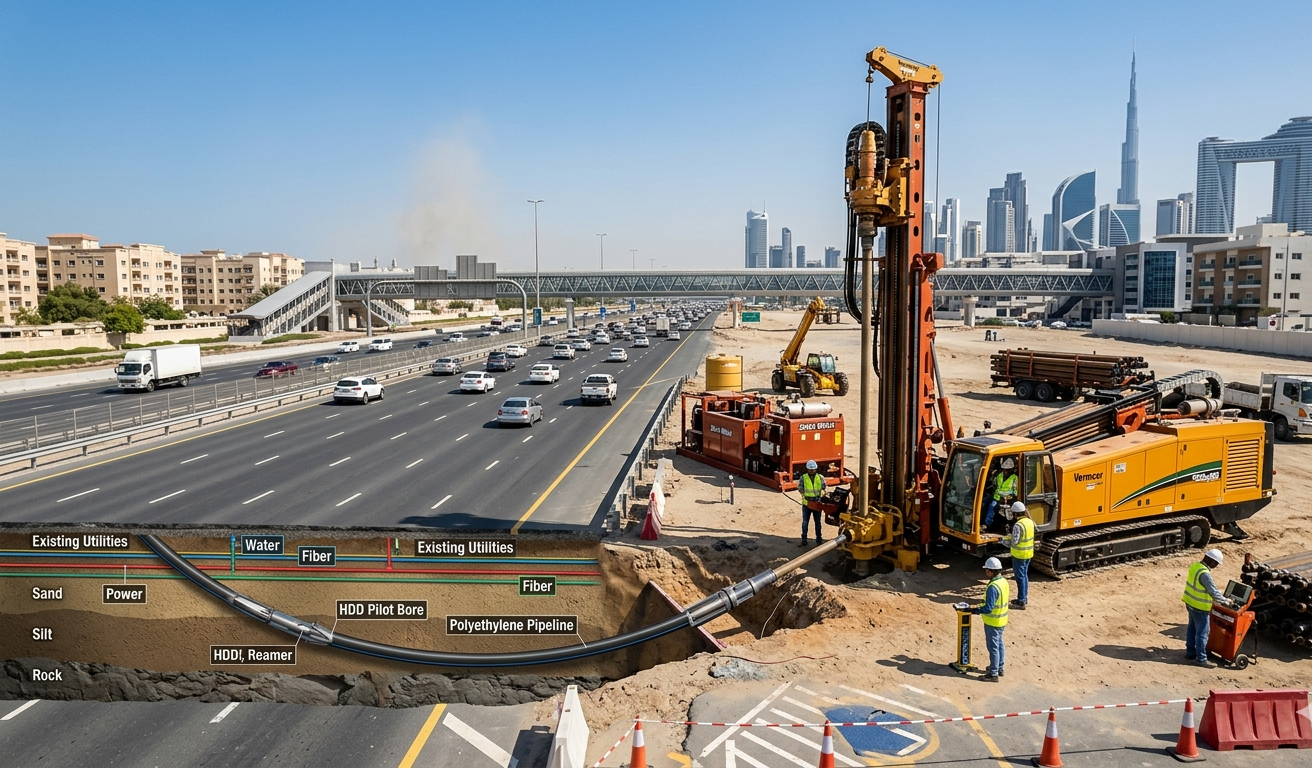
3. Make the first holes.
After the HDD machine plans, it starts to drill a small hole under the surface.
A lot of thought went into how this pilot hole will move in the ground. There is new tracking technology in HDD systems that lets them fine-tune the direction and depth of the drilling.
This hole will help you as you put the part in place.
- Making the hole bigger, which is also called reaming
After the pilot hole is made, reaming tools are used to make the hole bigger.
You need to know how big the hole is before you put in a cable or pipe.
This way, there is enough room below ground to put in utilities in a safe and effective way.
- Pipeline or Cable Installation
With care, the pipe or conduit needs to be pulled through the ground once the hole is ready.
Most of the roads and nearby areas will be fine since the work is being done below ground.
That’s why HDD is one of the cleanest and safest ways to set up programs right now.
- The last checks and tests
After the installation is done, engineers do one last set of tests and checks to make sure:
- How to stand up straight
- Safety-firing it in
- How to figure out what good is
- Safe links that keep things together
- Getting the job done quickly and well
When the site is cleaned up and fixed up, as little harm as possible is done to the outdoors
Benefits of NDRC and HDD Technology
Minimal Surface Disruption
While the work is being done, roads, sidewalks, and gardens are mostly left alone.
It takes less time to get around in traffic.
People can keep going with a few stops if there is less digging.
Made things safer
It’s less likely that underground utilities will be damaged if they can be found correctly.
Cut down on the time needed to finish a project.
There are times when HDD projects are finished faster than digging projects.
Helpful for the earth
If people dig less, there will be a lot less dust, trash, and damage to the land.
Cost-Effective Solution
As less work is done to fix and maintain the roads, the total cost of the project goes down.
How HDD will change the way we build underground
Overhead utilities are getting harder and harder to put in as cities get bigger. Hardware that uses HDDs is safer and faster to build right now.
At the moment, HDD is often used for
- Crossings of highway routes
- Electricity grids
- A company that does business in “Smart cities” is becoming more well-known. People like that use the Internet a lot.
Utilities can be laid underground with relative ease, making it a fantastic choice for modern construction projects.
People with extensive knowledge of HDD and NDRC are available to assist you.
A well-executed HDD project requires knowledgeable personnel, cutting-edge equipment, and meticulous preparation.
For dependable HDD and NDRC solutions in the UAE,
FGC Contracting LLC is the go-to firm for utility, installation, and subterranean infrastructure projects.
Using state-of-the-art drilling equipment and a wealth of industry experience, FGC Contracting guarantees projects are completed swiftly, safely, and with minimal surface damage.
In a nutshell,
Utilities are now laid underground using Horizontal Directional Drilling and NDRC. They make projects less risky, more efficient, and less troublesome.
Hardware-driven disks (HDDs) safeguard both current and future infrastructure. Minimizing the need for digging is another benefit. This is better for the earth and for road safety.
HDD is a smarter and more efficient way to bury infrastructure, and it’s becoming more and more important as the need for these kinds of projects grows.
